Thursday 14th September 1882
Morte-Hoe
On the whole I consider Devonshire (not to say Cornwall) undeveloped, from the watering-place point of view. Ilfracombe and Torquay are always to the fore, but take a “stick and a bundle,” and go down the coast for yourself, and you will only wonder why capitalists have not seized upon a dozen other places as good or better. Sometimes of course, the land is in old-fashioned hands. “When the old man dies” is not an uncommon formula in Devon and Cornwall. Why, then all sorts of miracles will be wrought. In fact, there is an immense future for the sea board of both the counties. As to the North Devon coast, it will soon be one long Brighton; that is to say, when a few old men who still belive in agriculture and oxen are content to die and liberate the cliffs and coves for building purposes.
I am now “at the point of death” a very cheerful place, commonly called “Morte-Hoe,” the rocks about here being most deadly to ships. This is at present a “stick and bundle” place, everything being undeveloped except shipwrecks. All the way from Ilfracombe to Bude there is one bitter cry going up for food and shelter; not so much from shipwrecked mariners, – who are well treated, and, I regret to say, drink far too much – but from wandering tourists, some with families, some without. I met a parson at Morte station, two miles from Morte. He was “on the wander,” had left his family far down the coast, and had gone forth to seek a new haven of rest for them. He declared there was not a bed to be got in Morte. It was raining. I was far from home, on somewhat the same errand. I turned to a party just in from Ilfracombe, they assured me that Ilfracombe itself was packed. Opf course, the was more or less a tourist fib, as I afterwards discovered, but I believed it, and trudged on to Morte to see for myself how matters were there. It was six o’clock; I met cants, carts and carriages with noisy occupants under umbrellas, all coming from Morte. They swarm in from Ilfracombe to spend the day here. Every evening on a fine day this tiny village upon a hill a mile from the sea is full with crowds. The one dirty little inn is never likely to be any cleaner until, as the Irishman said, it is pulled down. People must eat, and there is no rival inn. Here men, women and children in every grade of society from Ilfracombe, who have been week after week avoiding each other like strange cats are at last hustled together, eating bread and jam, struggling for cups of milk on the stairs, or for ginger beer in the porch. Ah! The “point of death” is a levelling place in more senses than one. I was so bewildered and surprised at this sudden spectacle of feasting and crowding in this little rocky fastness with the wide downs stretching up to this very inn, brown oxen look over the hedge, sheep bleating in the near heather above me and the sound of the sea deep down below, that I forgot that I was a lonely pioneer, perhaps without a roof over my head that night. Still I stood and watched van after van depart, when suddenly is struck me that the place was as still and solitary as any wayside hamlet.
Never believe people when they tell you there is no room. There may be no room one hour, and plenty the next, at these places. I effected without delay a lodgement at Morte, for I was bent upon seeing what it was that attracted these crowds. I found out the next day.
“Bracing!” No doubt! You can be blown off your feet most days if you like to climb to the top of any of the neighbouring furze hills. Last night there was a slight hurricane, which blew down the few remaining chimneys in this place, besides caving in three windows in the inn. The latter episode was not surprising as most of the windows were “loose and careless” before and rattled like skeleton bones in the gentlest and most summery breeze.
“A bold sea!” Decidedly! So bold that not a boat is to be seen on the coast for miles, except the life-boat which I am credibly (or otherwise) informed starts off every day as regularly as the vans, and comes back (like them) full “inside and out”
“Picturesque rocks!” Aye! So upright and picturesque that all along the coast they are worn into points and jagged edges like saws. Consequently all ships keep out to sea, well away from these “Morte” rocks. I have not yet seen a vessel within five miles of the shore.
Still this is not the secret of Morte. To find out what is, you must go down the long winding road, follow the donkeys and the people, old, young, and middle-aged, with baskets, pails, sticks and shovels. There’s business somewhere. I followed this mixed multitude. Some had not been before, some had, and all who went were sure, so I was told, to go again. I cannot pause on the road over tamer details, and to describe wayside rocky foundations, the cattle, the rabbits, the precipitous approaches to the magic scene which was soon to burst upon my wondering eyes. I call it “magic” now, because I have myself been under the spell. I thought it was merely idiotic at first
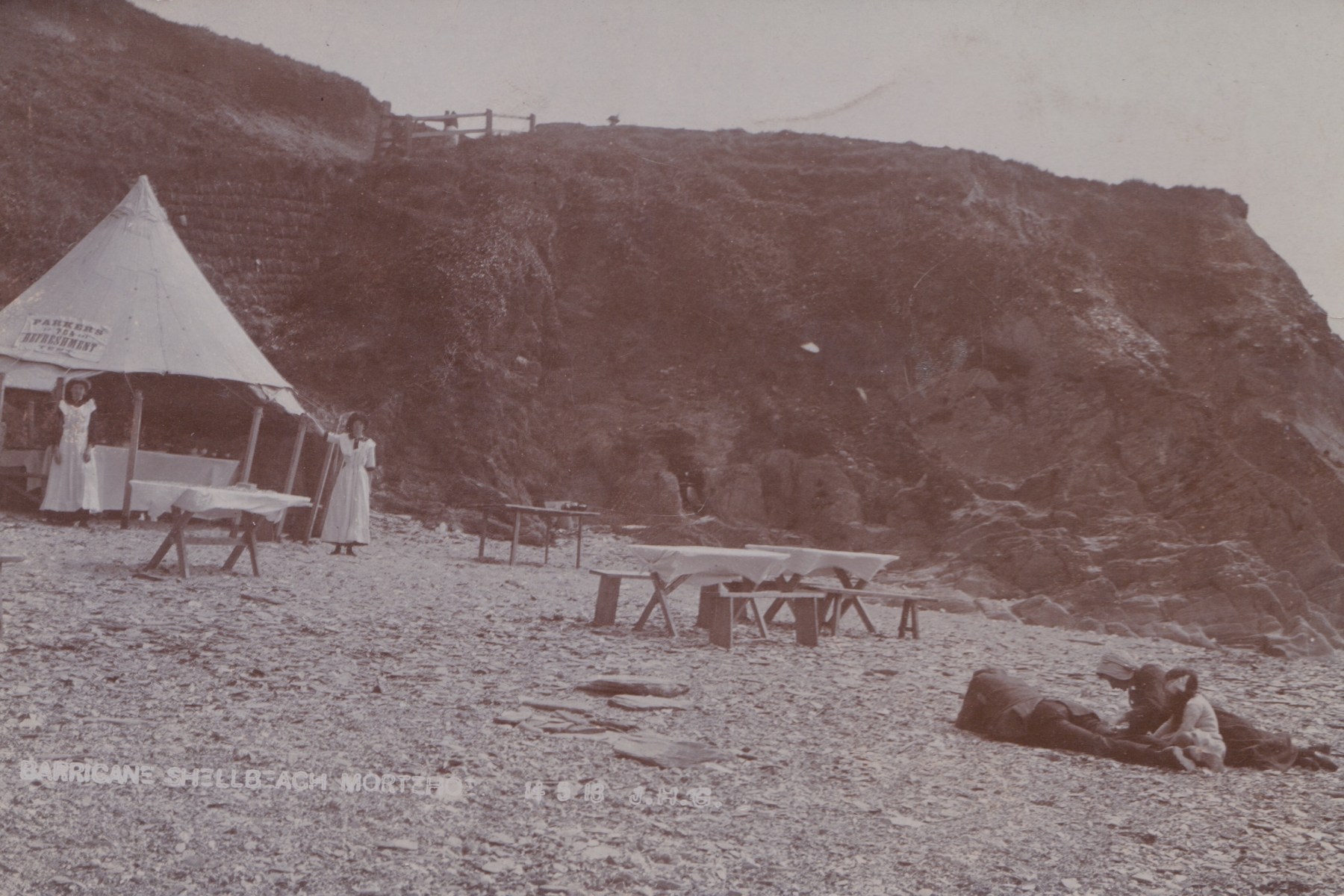
Winding down lower and lower, I followed the tourists, and still the sea seemed at the bottom of inaccessible cliffs. But the line of the cliff was falling rapidly, and at last I came out on a grassy flat, overlooking a large cove into which the sea flowed at full tide. I could hear voices though not many. I hurried to the brink “I will,” I said, “just look over into this cove and see what is going on below, this is evidently the point of attraction.” What did I see? I saw men, women, children, of all ages and sizes, lost to everything but the joys of eager pursuit. Most of them lay flat on their faces. The beach looked smooth and yielding to the body, but not pebbly nor sandy, and here and there it glittered strangely. Some of the people lay curled up in agonised attitudes, others were kicking and sprawling their legs unconsciously, most had their eyes closed to the ground, and, in fact most appeared to have almost buried their noses in the beach, as if they were truffle-hinting. This was too much for me. And then the silence, the solemnity, the absorption of this this mixed and scattered assembly. If I had been only children. But no – old and young were at it – at what?
In another minute or two I had clambered down; I was enchanted myself; I walked upon nothing but shells. I thought I would go about and see the groups, the ridiculous creatures! No one noticed me-they were far too busy. Why, there is a stout tradesman on all fours, scraping away; and I declare, there is a dignitary of the Church flat on his face! That elegant girl in the extreme of fashion, what an exhibition is she making of herself. Her attitude is too grotesquely contorted! She has twisted herself round like a snail These fat old women, sprawling here seem to have found happiness for the first time. Look at their jovial and contented faces! But how will they ever get up! Their heads are below their heels. What idiots they all look, and what deep contempt I entertained for them! Such a waste of time, too; how unprofitable and senseless! After all, what do they find? Broken shells! Here aand there a tiny one whole. What can be the good of-of (I forget the end of this reflection).
Dear me! A curious little fragment (I was on one knee). What a fine iridescent surface, and here is a bit of dazzling ultramarine, and have a delicate spiral, and here – only an empty periwinkle, but look there ( I was on both knees). How delicately veined is that molluse! What a singular action of water upon the surface of ! I declare by this time I had so far forgotten myself as to be flat upon my face. The stout tradesman in a plaid suit was puffing close by; I heeded him not; still be no longer appeared to be absurd. I thought his pursuit was rational, intelligent. I was my own – I had succumbed. No one ventures into this singular cove without doing homage to the shell deity of this place; all go flat down there sooner or later.
The Woolacombe sands with their fragments of barnacle covered up wreck are hard by, and they are delightful to walk upon for a safe three mile stretch, but these shell coves are the attraction which draws people who know of them for miles around, and it is this singular and fascinating feature, along with the delicious rocky pools and wild low-tide scenery, which will surely attract to Morte-Hoe a large resident summer population, now that at last the owners of the land have been induced to let it on building leases.
The old inn is doomed. A big hotel is already planned. A couple of stone lodging-houses have appeared facing the sea. In another ten years the “point of death” will be the life and health resort and summer abode of thousands, and it is every whispered that when this comes to pass, Ilfracombe will have to set its houses, or rather its lodging houses in order, if it is to hold its own against “Mortehoe”
 woolacombemortehoevoice.co.uk