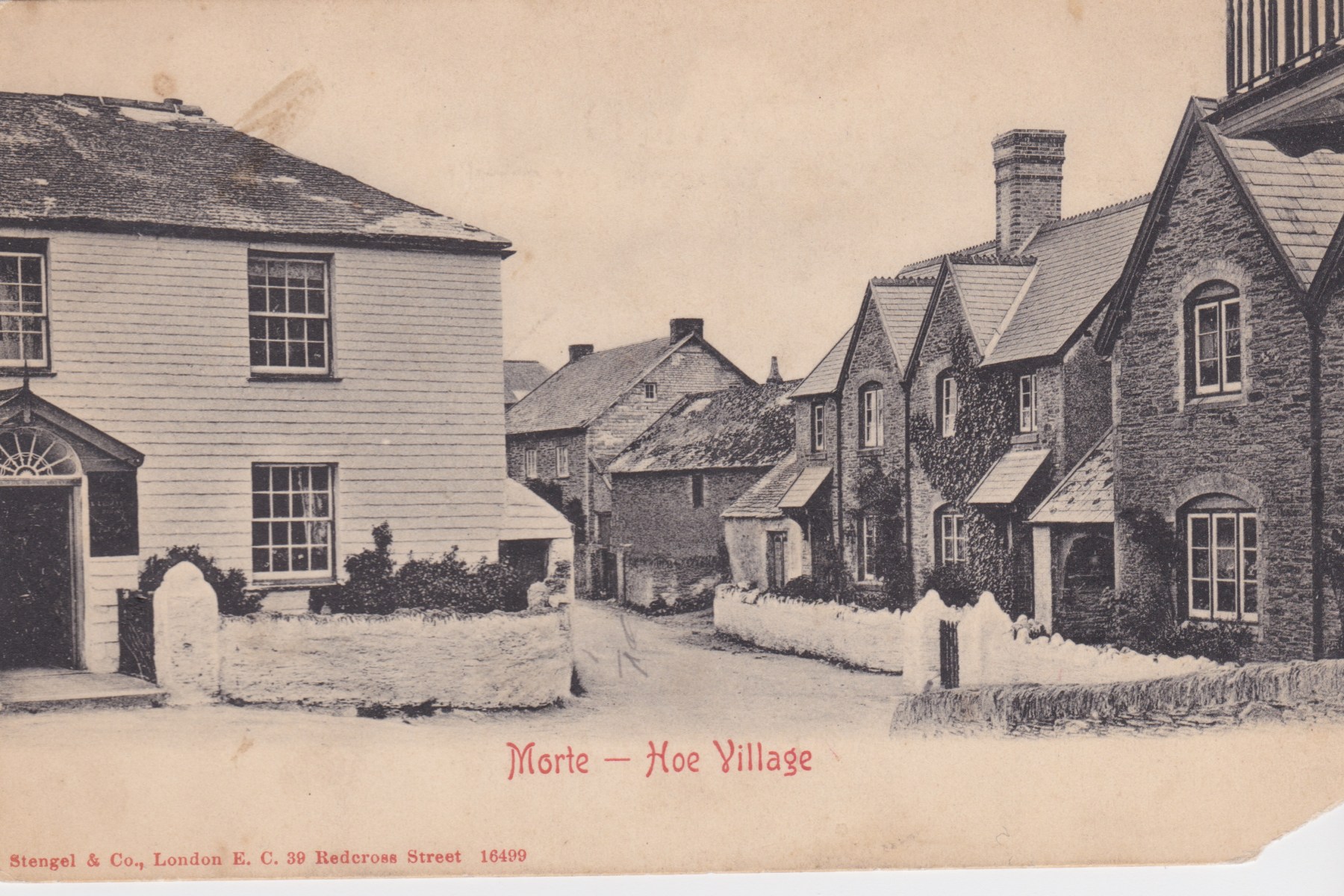
Monday 9th August 1886
Bristol Mercury
The claims made at this season by and on behalf of the numerous watering-places on our lovely coasts are sufficiently bewildering to the heads of families, who have to make a choice of their holiday resort, without the number being increased. But Morthoe has neither Mayor nor corporation to urge its bracing air, glorious hills, and lovely sands; and as these qualifications are essential to a health resort, and as they abound here in a pre-eminent degree, I take it upon myself to make this beautiful North Devon seaside village better known to a wide range of readers.
Competition and the resulting increase of wear and tear of life have made an annual holiday a sine qua non for the family bread-winner; the refinements of civilisation, entailing extra work on the housewife, makes a holiday essential for her; while the large requirements of educational standards, and perhaps not altogether perfect system of urban situation, make it desirable that the little masters and misses should also have a change, and what greater change can all these have than to leave the paved and walled city for the country lanes and open seaboard? It is true that these can be enjoyed and yet the advantages (and there are advantages) of a city habitation not be cast aside, at such places as Brighton, Ramsgate Yarmouth, Weymouth etc, but these places are empathetically not the place for a weary city man! Such an one wants, or should want, to get away from his daily paper and morning letters to places where but one post a day arrives or goes out; where a railway station is some miles distant; and from whence it is not easy to send a telegram. A place like this affords a real holiday, and being is such great contrast to the usual mode of living, affords just the “change” which most people want, but so few really take. We need not only new scenery, and fresh air, but new surroundings in every way; for once in twelvemonth we want to leave civilisation of pavements, street lamps, and heated rooms and heating food, and get in their Devonshire lanes, full of the scent of honey-suckle, the light of the pale harvest moon of evenings, the delicious country bread, baked in gorse heated ovens. To lie on the heath-clad hills and watch the heaving sea flow and ebb on the jagged shore and shining sands; to bathe in the clear blue water and rub its saltiness into the arms and breast; to live in the sun and sea-breezes; these it is which put fresh life into one, and having been once enjoyed, are topics not only of pleasant memories, but of future anticipations.
Let those who now spend the summer months at so called “fashionable watering places,” where the children must be “dressed,” make up their minds this year to sacrifice fashion and dwell for a month at some such place as Morth0e – letting the children run wild, careless of sashes and ribbons- and they will never regret the step. The present writer has spent four yearly holidays at Morthoe, and the fund laid of health and spirits has been so great that he looks forward to spending many more.
Morthoe is a small village six or seven miles from Ilfracombe; its station (two miles from the village) is on the main line from London of the London and South Western Railway, and through trains run frequently during the summer months; it is thus easily accessible from the metropolis. The air is particularly bracing as the village is three or four hundred feet above the seas level; one gets thus the advantage of mountain air. The name is evidently of foreign origin, and one of the promontory known as Morte Point ends in a line of dangerous rock or stone, is barely covered at high water. The coast just here is most dangerous, and of late years the government have built a capital lighthouse on Bull Point, which will repay the curious tourist to visit. In addition to a caloric-engine which compresses the air for sounding a fog-horn, and a beautiful flashing light (burning colza-oil), there is an arrangement by which a portion of the light is thrown down and reflected by mirrors, a ray being eventually thrown through red glass on to Morte Stone itself. Vessels coming up the channel know, if they see this red light, that they are in a line with the dreaded rock, and keep out to sea until the light is lost to them. Bull Point and Morte Point are about two miles apart in a straight line; between them is Rockham Bay, one of the most charming pebble bays on this most charming coast. The cliffs are very high and the shore very rocky. At low tide, however, a small stretch of firm sands affords safe bathing; the same tide leaves numberless pools among the rocks, and these with their many coloured seaweeds and exquisite anemones are beautiful studies. On the other side of the village a road cut in the face of the hill leads to Barracane – a noted shell beach – and to Woollacombe sands; these sands run southward for two miles, and are the admiration of all who see them. The shore declines very gradually, and is thus a most excellent bathing place, although I would always urge the cautious wisdom of bathing on the flow, and not on the ebb of the tide. The hills overlooking the sea are studded with footpaths, and no Lord of Manor forbids their ascent. Morte Point itself is guarded by a locked gate, but the courteous lessee lends a key to every applicant, and only has it guarded to keep out mischievous or careless children who might otherwise leave inner gates open, and thus let the cattle and sheep loose. From these hills one can see Gower and Oxwich Bay ( near Swansea) on the right, Lundy island in front and Hartland point on the left. On a still clear evening, few natural enjoyments are purer than sitting on Morte Point watching the sun retire, amidst golden splendours, for the night, and noticing the lighthouse throwing out their friendly yet warning beams.
Morthoe church can boast the burial place of William de Tracy, one of the slayers of Thomas Becket; its quaintly carved pew ends will astonish and surprise the antiquarian. Near the church is a Wesleyan chapel, and near this again is the Board school. About half a mile distant “the Grange;” this was originally built for private occupation by a friend of the writer, but was sold a few years ago to a syndicate (one of whose number is the Rev Urijah R. Thomas, a highly and deservedly respected Congregationalist minister of Bristol) to be used as a ministers’ home of lodgin house. A minister of any domination can be accommodated here, with his wife (if he has one) for a fortnight or three weeks at a nominal charge. Many an overworked minister has had reason to be thankful for the thoughtfulness that provides so delightful a change for so small a sum. Morthoe is pare excellence, the holiday and health resort for those who should with to leave the bustle and toil or ordinary life, and to seek under the broad canpy of heavens blue sky, in sight and sound of earths blue sea, that quite and repose which man’s higher nature requires to redeem it from ever grovelling in the dust of mere material things.
 woolacombemortehoevoice.co.uk