Thursday 19th September 1884
It ought to be easy for a man who has stayed for a few weeks in this beautiful home, to give some account of it and its surroundings. No place could be better situated. Standing on elevated ground and commanding a magnificent view of the sea (indeed it is almost surrounded by it), the position is as bracing as possible, and so extensive are the grounds, and so delightful that you would almost find recreation enough though you did not go a step beyond. But just a word or two about Morthoe itself. Nearly everybody knows this little village is situated some five or six miles south of Ilfracombe and that it takes its name form Death Rock which has proved so fatal to many a noble vessel and her crew. “Morte,” says the Devonshire proverb, “is the place on earth which Heaven made last and the devil will take first.”
What a chaos of rocks-ridges! Says Charles Kinglsey.” Old starved mothers earth bare worn ribs and joints peeping out through every fields and down; and on three sides of us the sullen thunder of the unseen surge.” There is a local saying that no power can remove this rock but that the number of “good-wives,” who hold undisputed sway over their “lords and masters.” “If this story were true,” says one, “possibly the Morte Stone need not long remain a terror to the mariners.” But so rugged and dangerous is this part of the coast, that weird stories are told of narrow escapes and of the sufferings of shipwrecks sailors. There isn’t a single board in the place, on account of the rocks and boulders which confront you everywhere. The village itself is unpretending enough. There is the church, chiefly of early English work, built, it is said by Sir Wiliam de Tracey, one of the murderers of Thomas-a-Becket. On the south side, in a mortuary chapel is an accident tomb, whose slab it is thought , commemorates the founder. There is also, adjoining the church, a Wesleyan Chapel, and not far off a little building, which is now occupied by the Salvation Army. A few straggling houses make up the rest of the village. You cannot do much therefore in the way of shopping. If you must go to a chemist it is necessary either to walk or ride to Ilfracombe . You have to do the same if you want draper, or books, or a post office order. Yet there are signs that Morthoe will one day become more important. Already two or three houses have been built near the church for the accommodation of visits and towards the Woollacombe Sands there are several of a more imposing character. Numbers of people come daily in the summer to see these sands, which stretch away for about two miles towrare Baggy Point, and the Barricane beach attracts almost as many, who come to hunt for shells. It is thought not unlikely that the whole of this splendid bay will by-andbye, face a good sized fashionable town, although the absence of trees in the neightbourhod, owing to its exposed position may prevent its becoming as Ilfracombe and some other places. However, a road has lately been made from the railway station to the sands and a hotel is in contemplation.
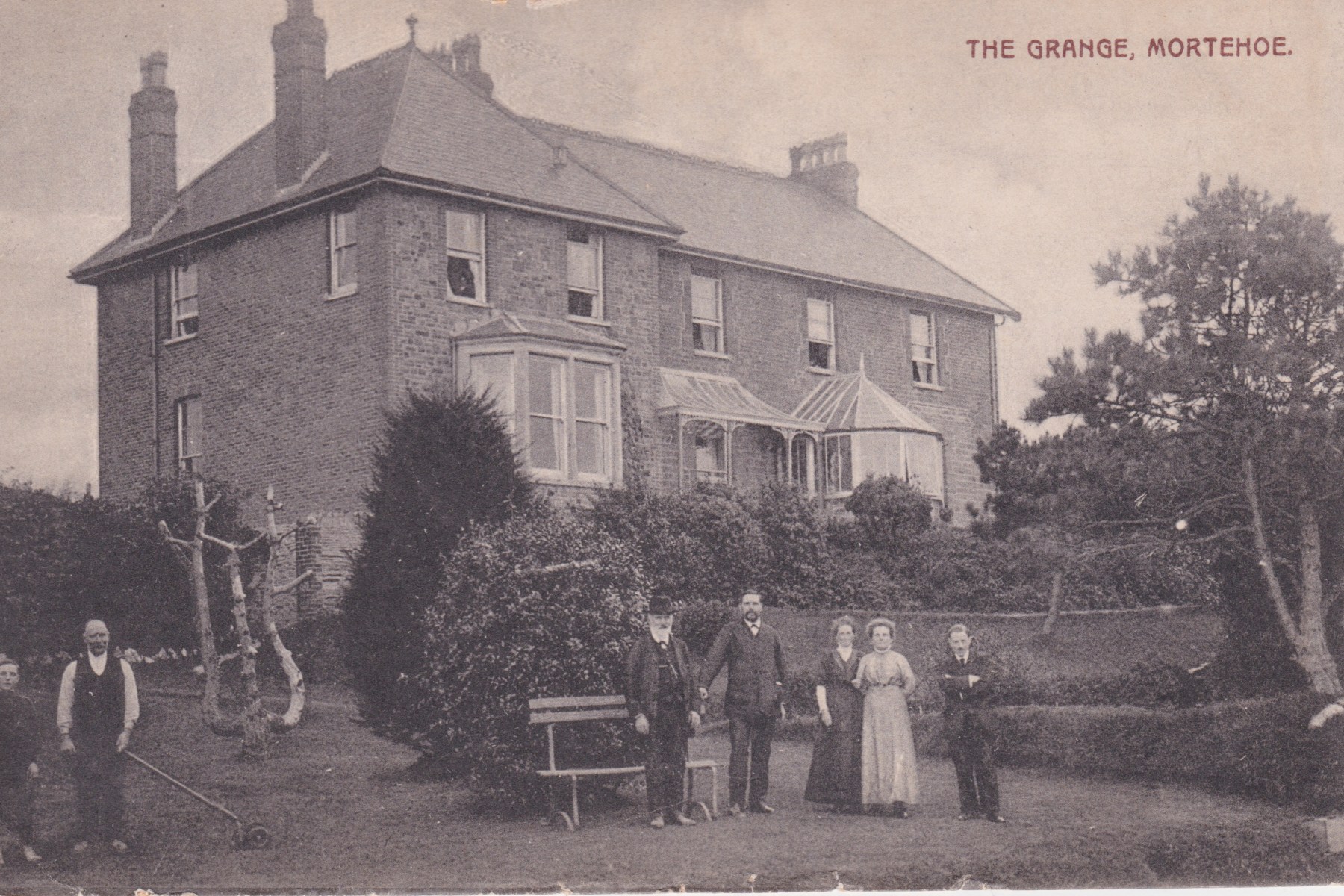
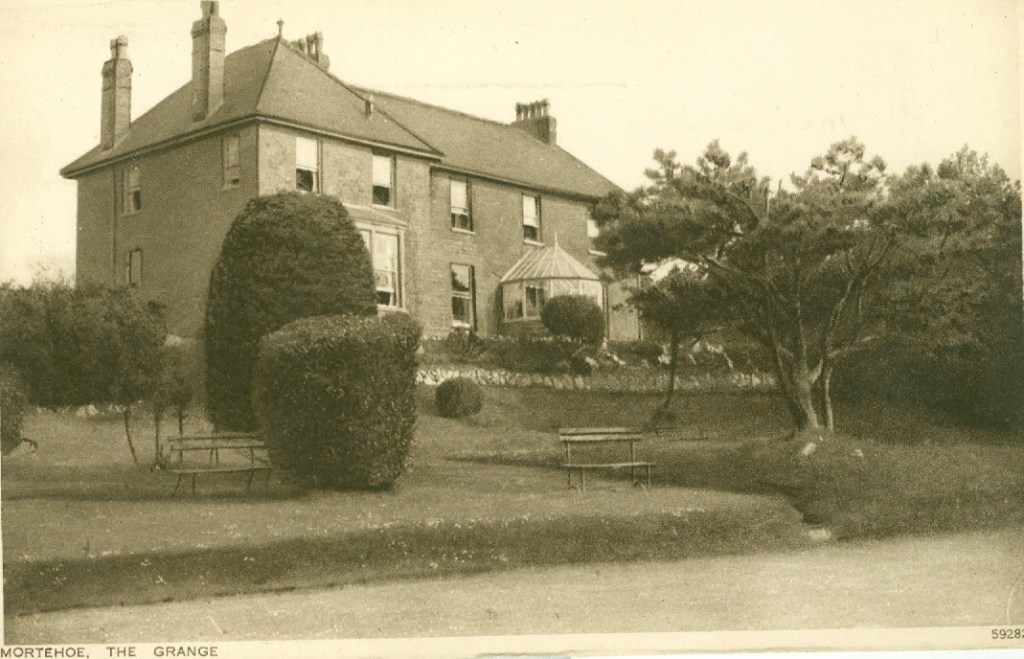
But to return to the Ministers’ Home or “The Grange” The Rev. Urijah R. Thomas of Bristol, some years ago conceived the happy odea of helping his brethren by providing for them this charming resort when jaded with work or broken down in health. Some of his friends thought that Ilfracombe would be a preferable place, but Morthoe appeared to him so much more bracing , and the quietude of the neighbourhood seemed so admirably suited for the purpose he had in view, that he decided upon it unhesitatingly, and after the lapse of several years he is still more convinced of the wisdom of that decision. And so am I. Though you are a little inconvenienced in some small matters, what an invigorating air you get! What repose! And yet what variety of interest and scene! If you wish, you can take the most delightful walks. Stroll along the road to the right towards Bull Point light-hosue, and you will find no lack of the picturesque – hills and valleys everywhere, and before you nearly all the way the open sea. Then there is a walk to Bennett’s Cave, and to Lee – one of the most exquisitely beautiful villages in England. Who could ramble through its woods without enjoyment. Nearer home again, there is the pretty ravine leading to Rockham Bay famed for its pebbles, as well as for the general beauty of its scenery. This is a favourite place for bathing too; rather dangerous at particular parts, and in certain states of the tide, but more sheltered from observers than the Woollacombe Sands. Taking everything together, we are convinced that no better spot that Morthoe could been selected for a Ministers Rest.
The arrangement of the house are as good as they could well be. The dining room, and drawing room are large and cheerful, and well furnished. The bookcase is filled with works specially suited to ministers. The bedrooms, though varying in size, are beautifully clean, airy and most of them command a good oulook. Provision is made for bagatelle, croquet and lawn tennis. Smokers may go to the Round Tower outside the house, as they indulge in the fragrant weed they can watch the ships go by and gaze upon the little village sleeping in the distance, and chat, as only ministers can, about churches, sermons, theology and books. The housekeep, Mrs Miles, with her excellent daughter, do all that is possible for the comfort of the guests, and Mr. Miles, who superintends the garden department, is unfailing in his geniality and readiness to oblige. In short, so much is done for the happiness of the ministers and their wives that after a stay of a fortnight or three weeks, they are eager to express their gratitude to God, as well as to the generous Founder and Warden, The entries in the visitors book – some in poetry, and some in poetical prose-give ample proof of this. Of course, if accommodation could be provided for children, many would be glad, but even this has not been forgotten by Mr. Thomas, and he is seriously thinking about devising some plan by which the little ones may be enabled to enjoy their holiday with their parents. But readers will naturally as, “How are the funds supplied for the maintenance of this beautiful home?” And a most important question too. Well, the ministers themselves are expected to pay for their board in proportion to their income and to the size of their family, information on all such particulars being given by the warden. Then a few large-hearted people are ready to contribute, and have done so for some years, and thus far, by these combined means all the expenses have been met. But it is clear that as the applications are more numerous every year, a more general support of the Home is needed, and I feel sure that Mr Thomas, who has himself spent so much money, and time, and labour upon this object, would feel very thankful to receive further promises of help. Surely, if the churches knew how much they benefitted by the change of scene and rest which their ministers enjoyed, they would be prompt and liberal in their gifts.
S. B. Stribbling
Southampton
 woolacombemortehoevoice.co.uk